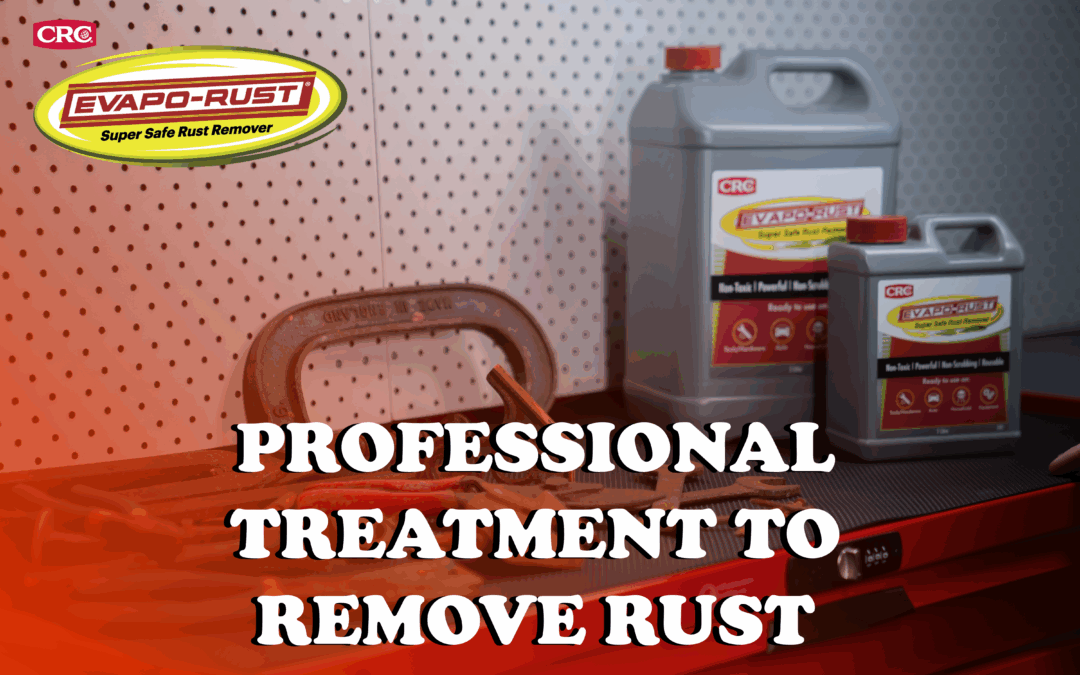
In many industrial environments, specialised workshops or restoration shops, treating rust is no longer just a matter of ‘removing it and that’s it’. When we talk about critical metal parts, complex mechanisms, mixed materials or finished surfaces, they require a professional treatment to remove rust from metal parts that combines effectiveness, safety and respect for the original component. In this article, we will take a closer look at this professional approach and see how Evapo-Rust fits perfectly into it.
Why is professional rust treatment different from simple cleaning?
Cleaning a rusted part for domestic use can be as simple as brushing, a quick dip in a bath, or repainting. However, in a professional or specialised environment, the application poses challenges such as:
• Preserving mechanical tolerances, gears, threads, and contact surfaces without altering their geometry.
• Treating parts with coatings, plastics, gaskets, or mixed materials that can be easily damaged.
• The risk of rapid re-rusting if the right conditions are not created after treatment.
• The need to reuse the cleaning solution, monitor its shelf life, and properly dispose of waste.
For these reasons, talking about ‘professional rust treatment on metal parts’ involves more than simply ‘removing rust’: it is a comprehensive process that ranges from preparation to final protection.
Stages of professional treatment to remove rust
1. Diagnosis and analysis of the part
Before taking action, inspect the part: what type of metal is it? What degree of rust does it have (superficial, deep pitting, metal loss)? Are there any coatings, rubbers, plastics or adjacent materials that could be affected? This analysis determines the technique, time and agents to be used.
2. Degreasing and surface preparation
Rust is removed more effectively if the surface is free of oils, greases and residues. A degreaser compatible with the part allows the removal product to penetrate properly.
3. Application of the rust removal agent
This is where Evapo-Rust comes in. Its selective chelation formula removes only rust without attacking the base metal or adjacent materials. This feature is crucial in professional jobs where the integrity of the part is at stake.
4. Process control
During the bath or immersion, it is advisable to monitor the solution: in professional environments, its useful life is measured (e.g., how the colour or density of the solution changes) to ensure effectiveness. Evapo-Rust’s technical documentation indicates that the reusable solution changes as it removes rust.
5. Rinsing, drying and final inspection
Once the rust layer has been removed, the part must be thoroughly rinsed, completely dried and checked for any residual rust, untreated pitting or collateral damage.
6. Protection and maintenance
Apply a corrosion inhibitor, protective coating, light oil or suitable paint. In addition, establishing a preventive maintenance plan, regular inspections and environmental control (humidity, storage) will ensure that the part maintains its integrity.
Professional use cases that deserve special attention
Buried/outdoor agricultural or industrial machinery
Parts exposed to water, salinity or aggressive environments require robust treatment: from immersion in Evapo-Rust to controlled drying and final coating. Poorly executed treatment can result in premature failure.
Classic or high-end automotive components
Old screws, brackets, frames, tanks and chassis have historical or functional value. Their treatment must be as ‘non-invasive’ as possible, without altering finishes, stampings or logos.
Collecting, architectural hardware and historical metals
Here, it is important to preserve the patina, original marks, manufacturing stamps and exact dimensions. Using a method that removes all rust but respects the details is key.
Specific advantages of Evapo-Rust for professional rust removal treatment
• Water-based, non-acidic formula, no need for vigorous scrubbing or sanding.
• Compatible with plastics, rubbers, non-iron oxide paints, other metals (brass, aluminium, copper), making it versatile for mixed parts.
• Reusable and cost-effective in industrial environments that handle large volumes of parts.
• Safe, biodegradable process with less environmental impact than aggressive acid treatments.
Tips for getting the most out of professional rust removal treatment
• Label the solution used: date, volume, degree of use, estimated date of depletion.
• For large parts, consider circulating the solution or immersing them in sections to ensure total coverage.
• Monitor the temperature: moderate temperatures (e.g. up to 50 °C) can accelerate the rust removal process.
• After treatment, do not store the part in humid environments: immediate exposure without protection promotes the formation of flash rust.
• Implement maintenance checklists: monthly visual inspection, light cleaning, reapplication of protection according to use.
When you need to restore critical parts, maintain exact tolerances, or protect valuable investments, the approach must be more than superficial. Thanks to Evapo-Rust, it is possible to perform safe, effective, material-friendly, and cost-effective treatments. Invest in a professional process and your metal parts will thank you with years of extra service.